On this page (14 sections)
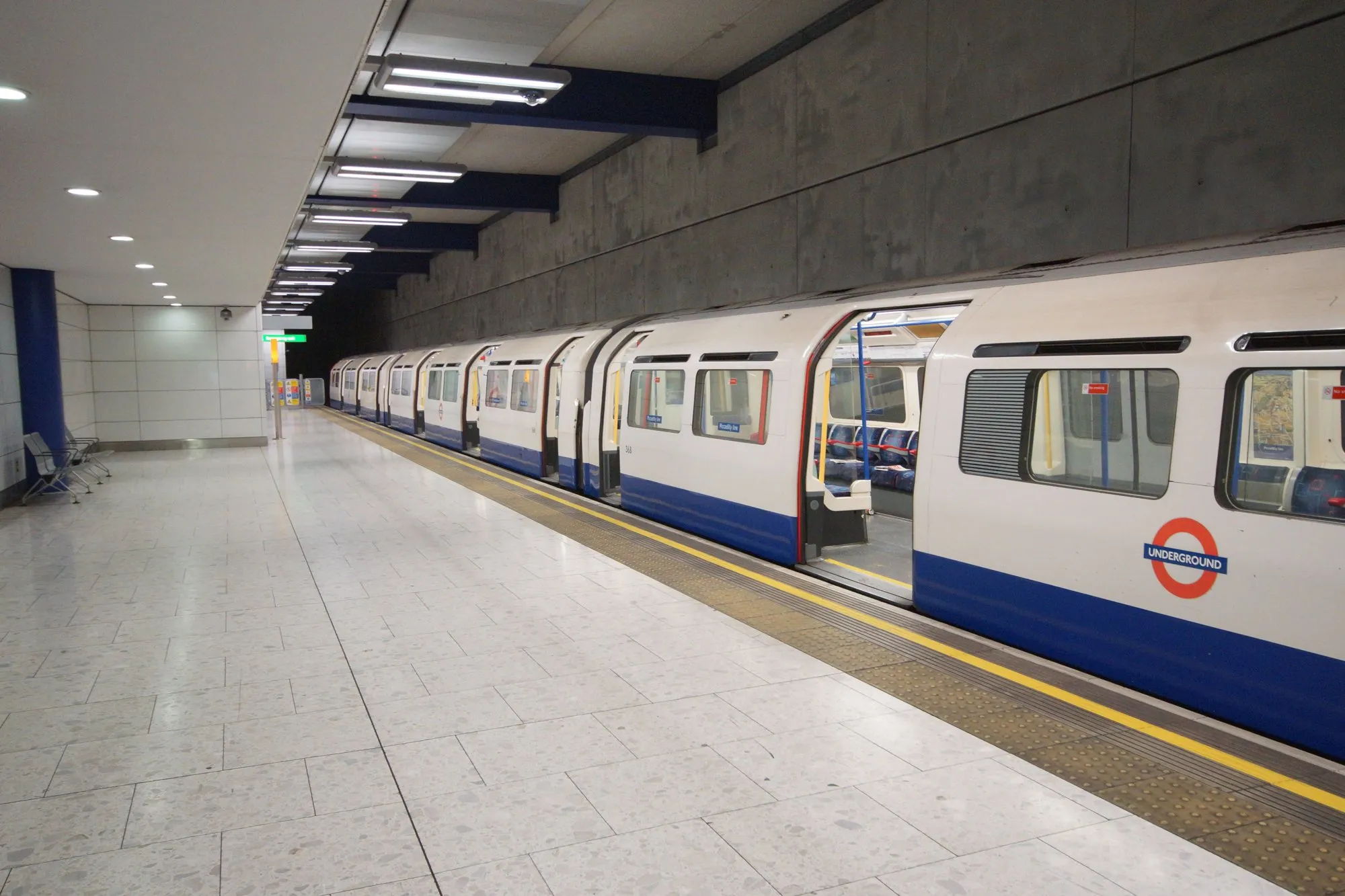
What is the Piccadilly Line?
The Piccadilly Line is one of the deep Tube lines on the London Underground, run by Transport for London. It crosses central London from the north-east to the west, then runs out past Hammersmith and Hounslow to Heathrow, calling at all four terminals. It is the original rail link to the airport, open since 1977, and it remains the cheapest train to Heathrow by a wide margin.
What you give up for the low fare is speed. The Piccadilly Line is a stopping Tube service, not an express, so the trip from central London takes around 50 minutes to an hour. That is roughly twice the time of the Elizabeth Line and more than three times a Heathrow Express journey. It is one of the three rail routes to the airport, all weighed up on the train to Heathrow page, and for many travellers the choice comes down to how much their time is worth on the day.
The Piccadilly Line earns its place for budget travellers, for anyone already on the line, and for very early or very late journeys, since it is the only route that runs through the night at weekends. It also reaches every terminal, including Terminal 4, which Heathrow Express does not serve at all.
Which Heathrow stations does the Piccadilly Line serve?
The Piccadilly Line reaches all three Heathrow Underground stations, and the way it gets to them is unusual. After Hatton Cross, the last stop before the airport, the line splits into two branches that rejoin, so which terminals your train serves depends on the train you board. Each station sits directly beneath the terminal it serves, with lifts and escalators up into the building.
Terminals 2 and 3
The shared central station serves both Terminal 2 and Terminal 3. Every Piccadilly Line train to the airport calls here, whichever branch it takes, so it has the most frequent service of the three stations. From the platforms, lifts and escalators bring you up into the central terminal area, with a short covered walk to either terminal.
Terminal 4 and the Hatton Cross loop
Terminal 4 sits on a single-track loop. Trains for Terminal 4 leave the main line at Hatton Cross, call at Terminal 4, then continue to the central station for Terminals 2 and 3, where they terminate. Because only some trains take the loop, Terminal 4 has a less frequent service than the central station, and it is not served at all during Night Tube hours.
Terminal 5
The trains that do not take the Terminal 4 loop run direct from Hatton Cross to the central station and then on to Terminal 5, the western terminus of the line. Terminal 5 therefore shares its trains roughly half and half with Terminal 4, so it too is less frequent than Terminals 2 and 3. The station is beneath the terminal, alongside the Heathrow Express and Elizabeth Line platforms.
How long does the Piccadilly Line take to Heathrow?
From central London, reckon on 50 minutes to an hour to the station for Terminals 2 and 3, with Terminal 5 a few minutes further and Terminal 4 reached by the loop. The line stops at every station along the way, which is why it is so much slower than the other two trains. Approximate times to the central terminal station, which you can confirm on the Transport for London journey planner:
- Hatton Cross: about 6 minutes
- Earls Court: about 40 minutes
- Piccadilly Circus: about 50 minutes
- Leicester Square: about 50 minutes
- Holborn: about 52 minutes
- Kings Cross St Pancras: about 55 minutes
These are platform-to-platform times on a single train, with no change needed, since the Piccadilly Line runs straight through all of these stations. Add the walk up to the terminal and through to your gate. For comparison, Heathrow Express covers Paddington to the central terminals in 15 minutes, and the Elizabeth Line takes about 30. Coming from the north of London, see Kings Cross to Heathrow for the route, since the Piccadilly Line runs direct from there.
How often do Piccadilly Line trains run to Heathrow?
Through the day, the central terminal station is busy, with the two branches sharing the service to Terminal 4 and Terminal 5. In broad terms:
- Terminals 2 and 3: a train every few minutes, since all airport trains call here
- Terminal 4: roughly every 10 minutes, on the trains that take the loop
- Terminal 5: roughly every 10 minutes, on the trains that run direct
Service is most frequent through the middle of the day and in the peaks, and thins out late in the evening. First trains reach the airport before 05:30 on weekdays, and the last evening trains run past midnight. Always check the front of the train or the platform indicator for its destination, because a Terminal 5 train will not call at Terminal 4 and the other way round.
Does the Piccadilly Line run all night?
Yes, on Friday and Saturday nights. The Piccadilly Line runs a 24-hour Night Tube service on those two nights, roughly every 10 minutes between Heathrow and central London through the small hours. It is the only rail route to the airport that runs overnight, which makes it the default for very early departures and very late arrivals at the weekend.
Two caveats. Terminal 4 is not served during Night Tube hours, so the overnight service reaches Terminals 2, 3, and 5 only. And the Piccadilly Line is in the middle of a long fleet and signalling upgrade, with new trains being introduced, so weekend night service is sometimes reduced for engineering work. Check the live status before you count on a night train, using the sources in the disruption section below.
How much does the Piccadilly Line to Heathrow cost?
Heathrow sits in Travelcard zone 6. A pay as you go single between any zone 1 station and the airport is £5.90 with contactless or a pay as you go Oyster card. It is charged at the same rate peak and off-peak, so there is no cheaper time of day. A paper cash single bought from a machine is £7.
The daily cap makes a return trip good value. Contactless and Oyster journeys across zones 1 to 6 cap at £16.30 a day, and a zones 1 to 6 Travelcard is valid to and from Heathrow. If you are starting outside zone 1, the fare is set by the zones you cross. Fares change, so confirm the current figure with the Transport for London single fare finder before you travel.
At £5.90 the Piccadilly Line is comfortably the cheapest train to the airport: well under half the Elizabeth Line fare of £15.50, and a fraction of a Heathrow Express single bought on the day.
How to pay for the Piccadilly Line
The simplest way is to tap in and out with a contactless bank card or a phone, exactly as on the rest of the Underground. The system charges the correct fare and applies the daily cap, with nothing to buy ahead. A pay as you go Oyster card works the same way, and a zones 1 to 6 Travelcard covers the journey if you already hold one.
If you prefer a paper ticket, single tickets are sold from the machines at the Heathrow stations, though they cost more than tapping in. Whichever method you use, there is no advance fare and no booking, so unlike Heathrow Express there is nothing to gain from buying early. Tap the same card or device in and out and you are charged correctly.
Piccadilly Line vs Elizabeth Line
This is the choice that matters most for value. The Elizabeth Line is faster and more comfortable, reaching the airport in about 30 minutes from central London on a spacious main-line train. The Piccadilly Line is slower, at 50 minutes to an hour on a cramped Tube, but much cheaper.
The numbers make the trade clear. The Piccadilly Line is £5.90 against the Elizabeth Line's £15.50 from zone 1, a saving of nearly £10, for around 20 to 25 extra minutes each way. If your time is worth more than that, take the Elizabeth Line. If you are counting the pennies, travelling light, or already on the Piccadilly Line, the Tube wins. Both serve every terminal, including Terminal 4.
Piccadilly Line vs Heathrow Express
This is the widest gap of the three comparisons, on both time and money. Heathrow Express reaches the central terminals from Paddington in 15 minutes; the Piccadilly Line takes around 50 from central London. On the day, Heathrow Express is £25 against the Piccadilly Line's £5.90, a difference of nearly £20.
The two suit opposite travellers. Heathrow Express is for those who want the shortest possible trip and will pay for it, especially booked ahead at its £10 advance fare. The Piccadilly Line is for those who want the lowest fare and have the time to spare. There is little middle ground between them, which is exactly the gap the Elizabeth Line fills.
Is the Piccadilly Line worth it?
For the right traveller, very much so. If cost is your main concern, nothing else by rail comes close to £5.90, and the line reaches every terminal directly without a change. It is also the only option through the night at weekends, which can save the price of a hotel or a late taxi.
It is the wrong choice if you are short on time, carrying heavy luggage, or travelling in the weekday rush, when a packed Tube with a suitcase is no fun. In those cases the Elizabeth Line is a better balance and Heathrow Express the fastest. For everyone else, the cheapest rail route to Heathrow does the job.
Step-free access and accessibility
The picture is mixed, and worth checking before you travel. At the airport, all three Heathrow Underground stations are step-free, with lifts between the platforms and the terminal halls above, so the airport end of the journey is straightforward with a wheelchair or a heavy case.
Central London is the problem. The Piccadilly Line is a deep Tube line through stations built more than a century ago, and most of them are not step-free, with stairs and escalators rather than lifts. Kings Cross St Pancras is a notable step-free exception, but many of the busy central stops, including Piccadilly Circus, Leicester Square, and Covent Garden, are not. Check the Transport for London step-free access guide for your stations, and consider the Elizabeth Line, which is step-free throughout, if that matters for your journey.
Luggage on the Piccadilly Line
This is the Piccadilly Line's weakest point for airport travellers. The deep Tube trains are narrow, with no luggage racks and no reserved space, so a large case has to sit in the aisle or by the doors. There is no booking and no charge, but there is also nowhere designed to put a suitcase.
In practice it is fine off-peak, when the trains are quiet and there is room to stand a case beside you. Between roughly 08:00 and 09:30 and 17:00 to 18:30 on weekdays, the central London trains are packed with commuters, and managing more than a cabin bag is genuinely awkward. If you are travelling as a group or with big cases, avoid those windows, keep the doorways clear, and allow extra time for stairs and escalators at the central stations.
Getting from the platform to your terminal
Every Heathrow Piccadilly Line station sits directly below the terminal it serves, so the walk is short and step-free. At the central station, lifts and escalators rise into the area between Terminals 2 and 3, with each terminal a few minutes' covered walk away and clearly signed. At Terminal 4 and Terminal 5, the platforms are beneath their own terminals and a single lift or escalator ride brings you up into the check-in hall.
Coming back, follow the Underground signs down from arrivals. At the central station and Terminal 5 the Piccadilly Line shares the concourse with Heathrow Express and the Elizabeth Line, so check the platform indicator for the next Piccadilly Line train rather than boarding the first one you see.
Delays and disruption
As part of the Underground, the Piccadilly Line is subject to the usual run of signal failures, planned engineering, and the occasional strike, and it is currently part-way through a major upgrade as new trains are introduced. Weekend engineering closures west of central London are common, and they can affect the airport branches, so the Tube is the route most worth checking before you set off.
Check the live Piccadilly Line status on the Transport for London service status page or in the TfL Go app before you travel, especially late at night, at weekends, and if you are relying on the Night Tube. If a closure affects the line, the Elizabeth Line and Heathrow Express run on entirely separate tracks and are usually unaffected. For notices across all three rail routes, see the train disruption page.