On this page (10 sections)
The road network at a glance
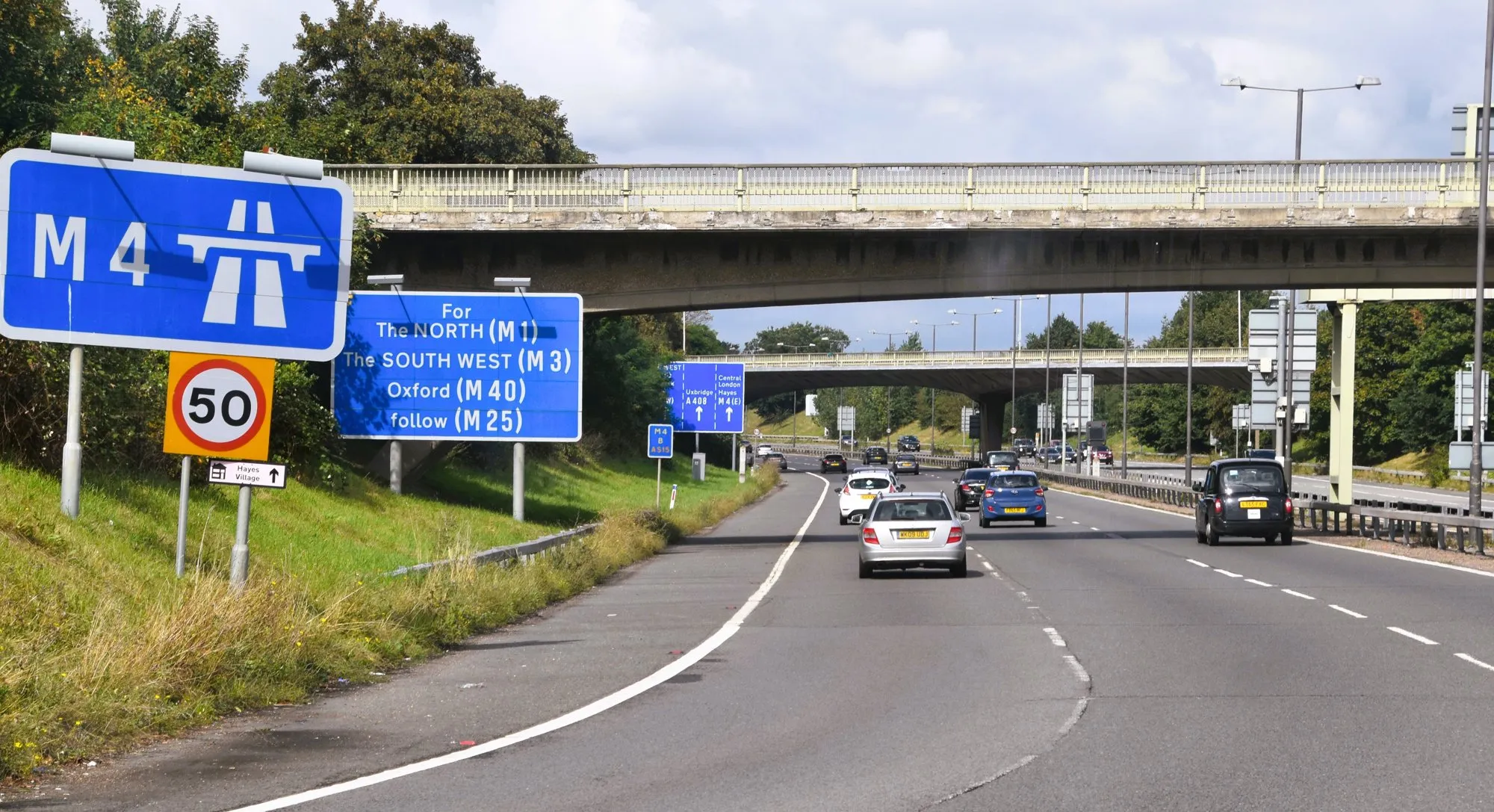
Heathrow hangs directly off the M25 and the M4, which makes it easy to reach by road and just as easy to get stuck approaching in the peaks. Three main routes do the work.
- M25 (London orbital): junction 14 is the closest M25 junction to the airport, used for Terminals 4 and 5. Junctions 14 and 15 frame the western edge of the airport. The M25 around here is notoriously busy at peak times and runs in cuttings, so there are few obvious diversions if it stops.
- M4 (London to Wales motorway): junction 4 is the closest M4 junction, used for Terminals 2 and 3 via the dedicated M4 spur road. Junction 4b a little east connects M4 traffic to the M25 for travellers going on to T4 or T5.
- A4 (Bath Road): the older A-road that runs parallel to the M4 between London and Slough. Slower than the motorway but a useful alternative when the M4 is closed for engineering, and a direct route into the central terminal area via the Boundary Tunnel.
- A30 and A3113: the southern approach from Staines and Egham via the Southern Perimeter Road, the standard route to Terminal 4 from the M25 junction 14.
The dedicated airport approaches are the M4 spur (a short purpose-built motorway off M4 junction 4), the Heathrow Boundary Tunnel (the free road tunnel into the central terminal area), and the T5 spur road (the dedicated approach to Terminal 5 from M25 junction 14). None of these carry a toll. Heathrow's own overview is on its by car page.
Terminal access by motorway junction
The biggest single thing a driver can get wrong on the approach to Heathrow is using the wrong junction for the terminal they want. Once you have come off the motorway at the right point, the in-airport signage takes over and is reliable; pick the wrong junction and you will spend twenty minutes circling the perimeter road.
| Terminal | Motorway junction | Approach road | Sat nav postcode |
|---|---|---|---|
| Terminal 2 | M4 junction 4 | M4 spur, Boundary Tunnel, central terminal area | TW6 1EW |
| Terminal 3 | M4 junction 4 | M4 spur, Boundary Tunnel, central terminal area | TW6 1QG |
| Terminal 4 | M25 junction 14 | A3113 Airport Way, Southern Perimeter Road | TW6 3YD |
| Terminal 5 | M25 junction 14 | T5 spur road, T5 roundabout | TW6 2GA |
Terminals 2 and 3 (the central area)
Both share the same approach: M4 westbound, leave at junction 4, take the M4 spur road, through the Heathrow Boundary Tunnel, into the central terminal area. From the M25, leave at junction 14 and double back along the Northern Perimeter Road, but the M4 approach is the standard one. T2 and T3 are next to each other inside the central area, signposted from the moment you exit the tunnel.
Terminal 4 (the southern approach)
Terminal 4 sits on the southern side of the airport and is reached differently from the others. From the M25, leave at junction 14, take the A3113 (Airport Way), continue straight through the next roundabout onto the Southern Perimeter Road, then through several roundabouts and traffic lights to the signed T4 slip road and short-stay car park. The route is well signposted but is longer than the central approach, and T4 is the most awkward of the four terminals to reach from any starting point that is not already on the southern side.
Terminal 5 (the western approach)
Terminal 5 has its own dedicated approach. From the M25 (north or south), leave at junction 14, take the T5 spur road, and follow it to the Terminal 5 roundabout where the signage splits between short-stay, business, drop-off, and onward roads. The spur road is purpose-built for T5 traffic and is rarely the bottleneck; if there is a delay on the T5 approach, it is usually on the M25 itself rather than the spur.
Traffic patterns and timing
The M25 and the M4 near Heathrow carry some of the heaviest traffic on the UK road network. The pattern is consistent enough that a driver can plan around it most of the time.
The worst windows, broadly:
- Weekday morning rush, roughly 06:30 to 09:30. M25 anticlockwise between junctions 12 and 15 backs up regularly, particularly between 07:30 and 08:30. The M4 inbound from junction 5 has its own peak in the same window.
- Weekday evening rush, roughly 16:30 to 19:00, especially on Fridays. M25 anticlockwise heading north and M4 westbound out of London both bunch up.
- Friday afternoon westbound, weather-dependent but often the worst single window of the week. Holidaymakers and weekend leisure traffic combined.
- Start and end of school holiday weeks, especially summer half-terms and the August holidays. The motorway capacity does not change but the volume does.
- Major events in London or at venues along the M25 (Twickenham rugby, Wembley, Heathrow's own large events). Look up event schedules before driving on the relevant evening.
Outside those windows the road moves freely most of the time. Off-peak from M25 junction 14 to a central London terminus is around 35 to 50 minutes; in the worst of the morning peak the same trip can take 90 minutes or longer. Allow at least an extra 30 minutes during peak periods and check live conditions on Google Maps or the National Highways site before you set off. This page does not carry any live traffic state because it changes too quickly to be useful here.
ULEZ and the road charges
Driving to Heathrow brings two financial considerations on top of any parking or drop-off fee.
ULEZ (Ultra Low Emission Zone)
The expanded Ultra Low Emission Zone covers all of Greater London including Heathrow, since the boundary moved out on 29 August 2023. Non-compliant vehicles pay £12.50 a day, 24 hours a day, every day except Christmas Day. Petrol cars meeting Euro 4 (typically post-2006) and diesel cars meeting Euro 6 (typically post-2015) are compliant and pay nothing. Run your plate through the TfL vehicle checker before you set off; the full picture, including how to pay and what happens if you do not, is on the ULEZ and Congestion Charge page.
Heathrow forecourt drop-off charge
If you are dropping someone at the kerb, the £7 forecourt charge applies on every entry to a terminal drop-off zone, with a 10-minute maximum stay. The charge is not negotiable and applies to any car. Detail and the free Park & Ride workaround are on the drop-off charges page. If you are collecting an arriving passenger, the pick-up page covers the slightly different rules; in short, you cannot wait on the forecourt and the car parks are the legitimate option.
What is not charged
Heathrow has no tolls. The Boundary Tunnel is free. There is no congestion charge or city access fee specific to the airport. If you are continuing into central London from Heathrow, the central London Congestion Charge (£18 a day) may apply during operating hours; that is a Transport for London scheme covered on the same ULEZ page.
Parking choices in brief
If you are parking rather than dropping off, four broad options. The parking hub covers each in detail; this is a one-paragraph summary for the driver planning the trip.
- Terminal Parking (formerly Short Stay): next to each terminal building, 2-minute walk to arrivals, paid by the band from £8 for the first 29 minutes (the T4 multi-storey is closed for redevelopment; use the T4 Park & Ride). Right for short visits and quick collections.
- Park & Ride (formerly Long Stay): out on the perimeter, free courtesy bus to the terminal door, 29 minutes free for drop-off and pick-up, paid by the day for longer stays. Cheaper for trips of a few days.
- Business Parking (Priority Park & Ride and Pod Parking): premium tier with faster transfers, mainly at T5 where the Heathrow Pod runs. Used by frequent travellers paying for closer access.
- Meet and greet: a valet drops your car at the terminal and a driver takes it to a holding lot. Convenient for travellers with heavy bags or tight timings; some operators include EV charging while you travel.
Drop-off and pick-up at the kerb
The forecourt rules at Heathrow are stricter than they look on paper, and they are the topic that catches most drivers out.
For drop-off, every car entering the kerbside zone outside any terminal pays £7 per visit, with a 10-minute hard cap on how long you can stay. Re-entering counts as a new £7. Free drop-off is at the Park & Ride for the relevant terminal, where 29 minutes are included and the courtesy bus handles the last leg. Full rules on the drop-off charges page.
For pick-up, the kerb is officially closed to waiting. Heathrow does not permit cars to wait on the forecourt and unattended cars are towed. A brief kerbside collection (your passenger already standing outside) triggers the same £7 ANPR charge. The legitimate options are the Terminal Parking car park, paid by the band, or the Park & Ride, free for the first 29 minutes. The pick-up page walks through the timing.
Electric vehicle charging at Heathrow
Heathrow is not a strong place to charge an EV. The airport ran an E-GAP charging trial that ended in April 2024, and the official position since is that no Heathrow-operated charging points are available in the car parks. The main on-site charging option for the general public is the Tesla Public Supercharger near Terminals 2 and 3, which sits in a Tesla-operated facility with 15 charging devices capable of up to 250kW. Despite the Tesla branding the chargers use the CCS connector and are open to any EV with the right port; a small car park entry fee applies for the Tesla site itself.
For travellers who need to charge while away rather than en route, the practical workaround is a meet-and-greet operator that includes EV charging in the service. Several Heathrow valet companies offer this and the cost is built into the booking. Otherwise, plan to arrive with enough charge to leave again.
If you are passing through, charging outside the airport is straightforward: the Park & Ride sites, several nearby retail parks and supermarkets, and the motorway service areas at Cobham (M25) and Heston (M4) all have public chargers. The TfL ULEZ position is unaffected (any EV is ULEZ-compliant by default), so the only road-charge issue for an EV driver is the £18 Congestion Charge if the trip continues into central London, where EVs now pay a reduced rate via Auto Pay rather than the historic full exemption. Detail on the ULEZ and Congestion Charge page.
The Heathrow Pod at Terminal 5
One small piece of Heathrow road trivia that affects drivers parking in the T5 Business Parking site. The Heathrow Pod is the personal rapid transit system that links the Business car park to Terminal 5 itself, a 6-minute driverless journey in a battery-powered four-seater pod. There are 21 pods running on 3.8 km of one-way guideway between three stations (two in the car park, one at T5). It opened in May 2011 and was the first commercially operating PRT system in the world.
For a normal driver, the Pod matters only if they have booked Pod Parking specifically. Park, walk to the nearest Pod station inside the car park, board the next available vehicle (no driver, no timetable, you call it like a lift), and step off at T5 arrivals or departures level. It is faster and quieter than a shuttle bus. For other Terminal 5 parking options, see the parking hub. For the deeper detail on the Pod itself, the T5 parking page will carry it in full when it ships.
Practical advice for the drive
A handful of small things that help on a Heathrow road trip.
- Use the per-terminal postcode in your sat nav, not the bare TW6. The postcode page lists each one. The wrong code routes you to the cargo area or a maintenance road.
- Trust the airport's signage from the moment you turn off the motorway. Heathrow's own signposting is more reliable than any sat nav for the last few hundred metres, and the road layout near the terminals does not always match what older devices think it should.
- Check the ULEZ position before you set off. A surprise £12.50 plus a missed deadline plus an £180 PCN is a bad outcome. The TfL vehicle checker takes 30 seconds.
- Budget extra time at peak hours. 30 minutes is the minimum buffer; 60 to 90 minutes is realistic for a Friday afternoon westbound run or a weekday morning M25 trip.
- Pay the forecourt fee on the day, not the day after. The 23:59 next-day deadline catches drivers who plan to "do it later"; it is easier to pay before leaving the airport.
- Plan for parking before you arrive. The right car park varies by terminal, by trip length, and by how much you mind a courtesy bus. The choice is easier made at home than at a Heathrow roundabout.
- If you are continuing into central London afterwards, the Congestion Charge applies in the central zone during operating hours, and electric vehicles now pay a reduced rate rather than nothing.
Driving home from Heathrow
The reverse journey works the same way as the inbound. M4 eastbound from junction 4 back into London, or onwards via the M25 from junction 14 to the rest of the country. The same traffic patterns apply but with the peaks shifted: M4 inbound is busiest on weekday mornings and clearer on Friday evenings, while the M25 around junction 14 anticlockwise is busiest on Friday afternoons heading out of town.
One thing worth flagging: the central London Congestion Charge bites if your route from Heathrow takes you into the central zone during operating hours (07:00 to 18:00 weekdays, 12:00 to 18:00 weekends, £18 per day). For most routes home, the M25 or the M4 in the other direction keeps you well outside the zone and the charge does not apply; for a route into the City or the West End, factor it in. The full picture is on the ULEZ and Congestion Charge page.
For travellers leaving the airport in a hire car, the car hire page covers desk locations and what is built into the rental agreement, including how the Congestion Charge usually flows back to you with an admin fee on top. For travellers weighing the drive against the alternative modes, the getting to Heathrow hub compares rail, coach, taxi, and car side by side.