On this page (13 sections)
What is the Elizabeth Line?
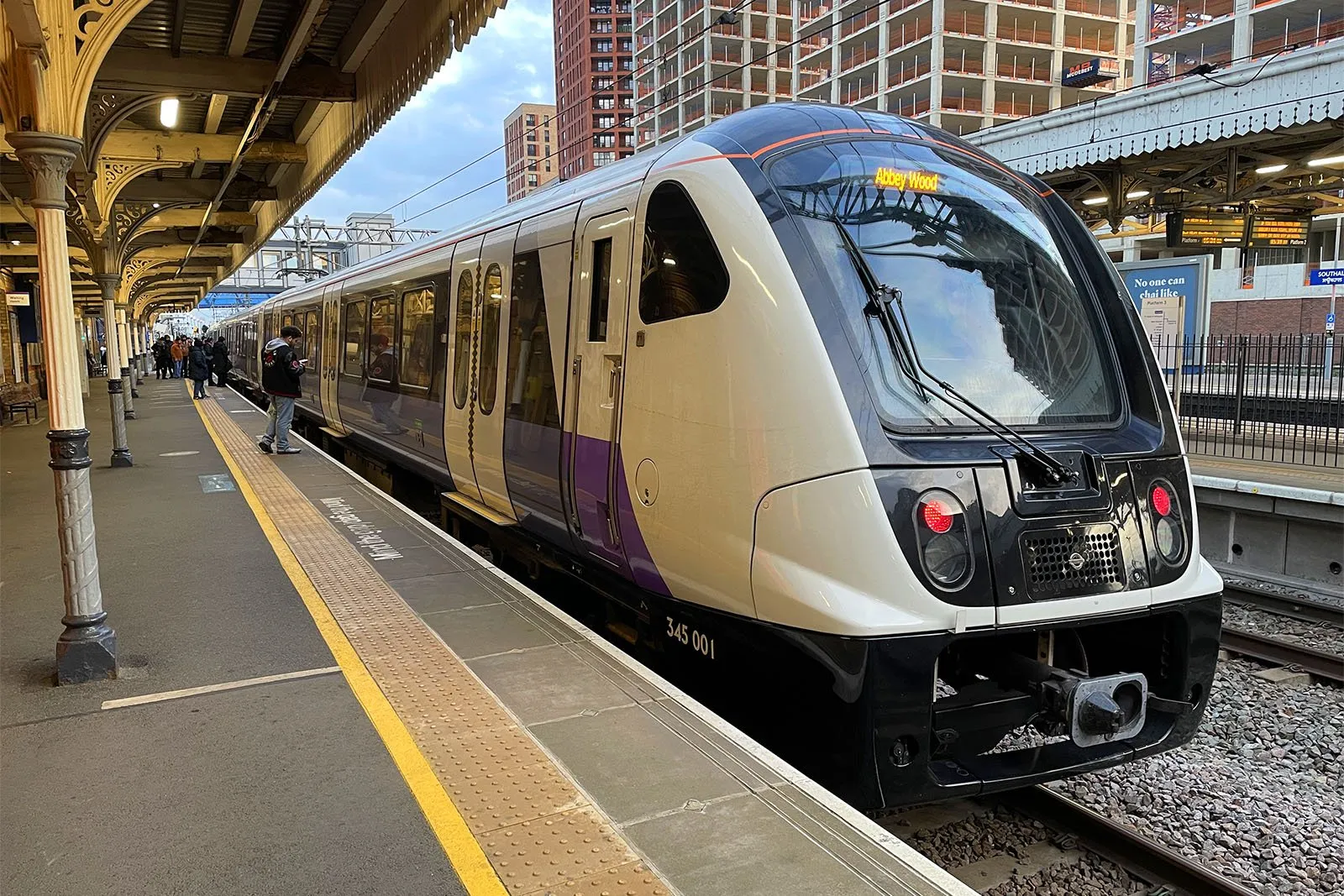
The Elizabeth Line is a high-frequency railway across London, run by Transport for London. It opened in 2022 and runs from Reading and Heathrow in the west, through a tunnel under central London, out to Shenfield and Abbey Wood in the east. For airport travellers, the part that matters is the western end, where trains branch off the main line to call at Heathrow.
Unlike Heathrow Express, which is a dedicated airport shuttle, the Elizabeth Line is part of the wider London network. You tap in with the same contactless card or Oyster you would use on the Underground, the daily fare cap applies, and the trains carry commuters and airport passengers alike. It is one of three rail routes to the airport, alongside Heathrow Express and the Piccadilly Line, all set out on the train to Heathrow page.
The appeal is directness and price. The Elizabeth Line runs straight across the middle of London, with stops at Paddington, Bond Street, Tottenham Court Road, Farringdon, and Liverpool Street, so you often reach the airport without changing trains. It costs a fraction of Heathrow Express and runs more comfortably than the Piccadilly Line, which is why it has become the default choice for many.
Which Heathrow stations does the Elizabeth Line serve?
Heathrow has three Elizabeth Line stations, and the line is the only train that reaches all of them. Each sits directly beneath the terminal it serves, with lifts and escalators up into the building. The station you want depends on your flight, so check your terminal before you travel.
Terminals 2 and 3
The shared central station serves both Terminal 2 and Terminal 3. Every Heathrow Elizabeth Line train calls here, so it has the most frequent service. From the platforms, lifts and escalators bring you up into the central terminal area, with Terminal 2 a short covered walk one way and Terminal 3 the other. Allow a few minutes either side.
Terminal 4
Terminal 4 has its own station, and the Elizabeth Line is the only train that serves it directly. This is the key reason to choose it if you are flying from Terminal 4: Heathrow Express does not stop there at all. The station is beneath the terminal, a short step-free walk from the check-in hall.
Terminal 5
Terminal 5 also has a dedicated station, shared with Heathrow Express and the Piccadilly Line. The Elizabeth Line service to Terminal 5 is less frequent than to the central terminals, so check the next departure if you are heading there. As with the others, the platforms sit directly below the terminal.
How long does the Elizabeth Line take to Heathrow?
From Paddington to the station for Terminals 2 and 3 is around 30 minutes. Terminal 4 and Terminal 5 are a few minutes further on. The line is slower than Heathrow Express because it makes several stops on the way out of London, but the trade is a direct ride from far more of central London. Approximate journey times to the central terminal station, which you can confirm on the Transport for London journey planner:
- Paddington: about 30 minutes
- Bond Street: about 33 minutes
- Tottenham Court Road: about 35 minutes
- Farringdon: about 38 minutes
- Liverpool Street: about 40 minutes
- Canary Wharf: about 45 minutes
- Stratford: about 45 to 50 minutes
These are platform-to-platform times. Add the walk up to the terminal and through to your gate, and remember that the eastern stations are quicker to Terminal 4 or Terminal 5 on the trains that run there directly. For comparison, Heathrow Express covers Paddington to the central terminals in 15 minutes.
How often do Elizabeth Line trains run to Heathrow?
The central terminal station has the most frequent service, with the two satellite stations sharing the trains that continue beyond it. In broad terms, during the day:
- Terminals 2 and 3: around six trains an hour, roughly every 10 minutes
- Terminal 4: around four trains an hour, roughly every 15 minutes
- Terminal 5: around two trains an hour, roughly every 30 minutes
The trains for Terminal 4 run east to Abbey Wood by way of Canary Wharf, and the trains for Terminal 5 run to Shenfield by way of Stratford, so the branch your train takes through London depends on which Heathrow station it started from. Service is most frequent through the middle of the day and thins out late at night. The first trains run before 05:30 and the last leave the airport around midnight; check the live Elizabeth Line timetable for the exact first and last departures on your date.
How much does the Elizabeth Line to Heathrow cost?
Heathrow sits in Travelcard zone 6. A pay as you go journey between any zone 1 station and the airport is a flat £15.50 since March 2026. There is no off-peak rate on this route: the same fare applies all day, every day, including weekends and public holidays. This is higher than an ordinary zone 1 to zone 6 fare, because the airport carries a premium, and the fare rose from £13.90 in early 2026.
The saving grace is the daily cap. Contactless and Oyster journeys across zones 1 to 6 cap at £16.30 a day, so a same-day return to the airport costs only 80p more than a single. Beyond that you travel free for the rest of the day within those zones. A zones 1 to 6 Travelcard is also valid to and from Heathrow on the Elizabeth Line.
If you start outside zone 1, the fare is set by the zones you cross rather than the flat zone 1 rate, and the relevant daily cap applies. Fares change, so confirm the current figure with Transport for London before you travel.
How to pay for the Elizabeth Line
The simplest way is to tap in and out with a contactless bank card or a phone, exactly as you would on the Underground. The system charges the correct fare and applies the daily cap automatically, so there is nothing to buy in advance and no ticket to collect. A pay as you go Oyster card works the same way for journeys between Heathrow and central London.
If you prefer a paper ticket, single tickets and Travelcards are sold from the machines at the Heathrow stations and at every station on the line. Whichever method you use, the fare is the same, so there is no advantage to booking ahead the way there is with Heathrow Express. Tap the same card or device in and out and you are charged correctly.
Elizabeth Line vs Heathrow Express
This is the choice most travellers actually face from Paddington, because both trains start there. The honest split is speed against price. Heathrow Express reaches the central terminals in 15 minutes; the Elizabeth Line takes about 30. On the day, the Elizabeth Line costs £15.50 against £25 for a Heathrow Express single, so you pay roughly £10 for the time saved.
Heathrow Express pulls ahead only if you book its £10 advance fare well in advance, which undercuts the Elizabeth Line and is still faster. The Elizabeth Line wins on flexibility, since there is nothing to book, and on reach, since it runs directly to Bond Street, Tottenham Court Road, Farringdon, and Liverpool Street rather than terminating at Paddington. It is also the only one of the two that serves Terminal 4. See the full case for the faster but pricier Heathrow Express if minutes matter more than money.
Elizabeth Line vs Piccadilly Line
The Piccadilly Line is the cheapest rail route to Heathrow and the slowest. It is a deep Tube line with frequent stops, so the trip from central London takes 50 minutes to an hour, against about 30 on the Elizabeth Line. The Piccadilly Line fare is lower than the Elizabeth Line premium, and it too serves every terminal including Terminal 4.
The Elizabeth Line is the better choice when you want more space, a smoother ride, and a faster journey, and you do not mind paying the higher airport fare. The Piccadilly Line earns its place when cost is the deciding factor, when you are already on it, or late at night and at weekends when it runs more often. The cheapest direct rail option for most budgets is a genuine toss-up between the two, decided by how much your time is worth on the day.
Is the Elizabeth Line the best way to Heathrow?
For most travellers, yes. It is direct from a long stretch of central London, it reaches every terminal including Terminal 4, it costs far less than Heathrow Express on the day, and it is faster and more comfortable than the Piccadilly Line. If you are starting anywhere near Bond Street, Tottenham Court Road, Farringdon, Liverpool Street, or Canary Wharf, it usually saves you a change as well as money.
Two cases point elsewhere. If you need the shortest possible trip and you are at or near Paddington, Heathrow Express is worth its premium, especially booked ahead. If cost is the only thing that counts, the Piccadilly Line is cheaper still. Outside those two, the direct train via central London is the sensible default.
Step-free access and accessibility
The Elizabeth Line is one of the most accessible railways in the country. Every station on the line is step-free from street to platform, with lifts where needed. At the Heathrow stations and across the central London core, there is level boarding between the platform and the train, so there is no gap or step to manage with a wheelchair, a pushchair, or a heavy case.
At the airport, lifts and escalators connect the Elizabeth Line platforms to the terminal halls above, so the whole route from train to check-in is step-free. Trains have dedicated wheelchair spaces, and Transport for London offers turn-up-and-go assistance without booking. If you are arriving and need help onward through the airport, see your terminal page for the assistance points and the wider train to Heathrow guide.
Luggage on board
There is no luggage booking and no charge on the Elizabeth Line. Trains have luggage racks and open areas near the doors, and the carriages are wide with plenty of standing room, so a large case is rarely a problem outside the busiest times. Keep the aisles and doorways clear so other passengers can move through.
The honest caveat is the peak. Between roughly 08:00 and 09:30 and again from 17:00 to 18:30 on weekdays, the central London trains fill with commuters, and a full set of suitcases can be awkward to manage standing in a busy carriage. If your flight time allows, travelling either side of those windows is far more comfortable with bags.
Getting from the platform to your terminal
Every Heathrow Elizabeth Line station sits directly below the terminal it serves, so the walk is short and step-free. At the central station, lifts and escalators rise into the area between Terminals 2 and 3, with each terminal a few minutes' covered walk away and clearly signed. At Terminal 4 and Terminal 5, the platforms are beneath their own terminals and a single lift or escalator ride brings you straight up into the check-in hall.
Coming back the other way, follow the purple Elizabeth Line signs down from arrivals. The signage at all three stations is consistent, and the platforms are shared with Heathrow Express at the central station and Terminal 5, so check the board for the next Elizabeth Line service rather than boarding the first train you see.
Delays and disruption
The Elizabeth Line is generally reliable, but as a cross-London railway it can be affected by signalling faults, planned engineering, and knock-on delays from the wider network. Most disruption is short, and the high frequency means a cancelled train is usually followed by another within minutes at the central terminals, though gaps are longer at Terminal 4 and Terminal 5.
Before you travel, check the live Elizabeth Line status on the Transport for London service status page or in the TfL Go app, and National Rail for the wider picture. For current notices across all three rail routes to the airport, and what to do if a delay puts your flight at risk, see the train disruption page.